|    LinkedIn   |   E-mail   |    Résumé/CV    |    Facebook   |    Twitter   |    Video Stories   |   Photography   |

23 September 2009

Fireworks at Opening of UN General Assembly

The United Nations General Assembly opened in New York Wednesday with eye-opening speeches from leaders of three of the world's most controversial nations. United States president Barack Obama set the meeting abuzz with his first speech to the UN.

The governing body made of 192 nations is likely to be one of Obama's largest focuses in dealing with the numerous foreign policy challenges he and his administration face. He also faces a daunting task in regaining the trust of the body after it was largely undermined under recent US presidencies, including George W. Bush's administration, which sidestepped the UN and its advice when it invaded Iraq in March 2003.

Obama's standout talking point was when he pitched the Assembly on a different America under his presidency. "We have re-engaged the United Nations," he said, going on to lay out the importance of working together, as well as the policy changes he has already implemented nine months into his first year as president.

He also called out nations, though not by name, that he said have showed "reflexive anti-Americanism" in dealing with some of the more serious issues brought to the Assembly in recent years.

This proved to be a fitting starting point for two speakers who followed Obama: Libyan leader Muammar Gadhafi, who spoke directly after Obama, and Iranian president Mahmoud Ahmadinejad.

Gadhafi (at left) made his first appearance at the annual meeting forty years into his reign as leader of Libya, but also as president of the African Union, which has been pressured recently to take control of several crises across the African continent.

He was allotted 15 minutes to speak, but went for 90 in a speech that urged the Security Council to adopt an African seat, but also strayed to hit on subjects ranging from the Taliban, to Iraq, an Israeli-Palestinian state, and the H1N1 virus. He also at one point said the Security Council should be renamed the "Terror Council" because of the power the veto nations have over the Council. He also tore up paper he represented as the UN Charter, which drew criticism from other leaders, including UK Prime Minister Gordon Brown.

Despite his wide-ranging criticisms of the western world's "agenda" and his displeasure with the UN bodies in general, he did offer a glimmer of approval for Obama when he said he wished the new president would have a lengthy presidency.

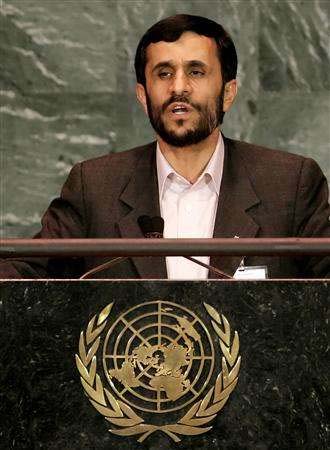
Possibly the most important speech of the day, however, was made by Iran president Mahmoud Ahmadinejad in his first major speech to the UN and first on US soil since his controversial election in June.

Ahmadinejad defended his presidency and called the election, rocked by massive protests after allegations of fraud, an homage to the people and "fully democratic." In classic Ahmadinejad fashion, he also delivered backhanded attacks on Israel and the United States, eventually prompting walkouts by several western diplomats, including a handful from the US and Canada.
The Security Council did break ground in dealing with one of its long-standing issues: dealing with Iran's nuclear ambitions. The five nations with veto power - China, Russia, Britain, France, and the United States, with Germany also signing on - issued a statement threatening further sanctions should Iran not cooperate in talks regarding its nuclear program, the two former being important because of their prior reluctance to take a major stance on Iran's nuclear ambitions because of trade agreements.

The nations set an October 1 meeting deadline by which Iran can decide whether or not to attend a meeting to begin negotiations regarding its nuclear program. UK Foreign Minister David Miliband read the statement, threatening harsh sanctions should Iran not comply. Ahmadinejad has acknowledged he will consider letting his nuclear scientists meet with western scientists to discuss the state's nuclear situation.

While the meeting's importance has diminished in recent years and been mostly a place for disgruntled leaders to voice their opinions or other leaders to push their agendas, Wednesday's meeting laid out many of the glaring problems facing the UN both internally and on the international scale.

It also sets quite the stage for Thursday and Friday's G20 Summit in Pittsburgh, where the organization will again meet to tackle the issues facing the global economy and financial institutions.

The two meetings are major steps in the Obama Administration's intent to improve foreign relations and to better coordinate on a global level with other nations to attack the global economic crisis as well as Afghanistan, Iraq, and other flash-point areas such as Somalia and Myanmar, where organized multi-national efforts are either under way or being discussed to stabilize the respective state governments.

Bookmark and Share

27 July 2009

Why Iran's Election Gives Israel The Nuclear Upper Hand

The United States has for years been both a mediator and flash point for international conflict, especially in the Middle East. Now, it could be stuck between two bitter enemies' nuclear posturing. It appears that Israel could be using the United States as leverage in its war of words with Iran, which could all be led back to US-Israeli relations and a dubious Iran election.

The smoldering conflict between Israel and Iran over both nations' nuclear programs was stoked Monday when Israel's Defense Minister (at right) said that "no option should be removed from the table" regarding his nation's stance on engaging a nuclear Iran. He did, however, concede that diplomatic steps would be ideal and the first option in addressing Iran's actions in its nuclear development, which Israel says is a grave threat.

The remarks came on the visit of US Defense Secretary Robert Gates to Israel in order to help work towards a more peaceful Middle East and just a day after US Secretary of State Hillary Clinton called Iran's nuclear ambitions "futile."

Tensions between Israel and Iran have escalated in recent years as Israel, thought throughout the international system to possess a nuclear weapon, has repeatedly drawn (and returned) threats from Iran, which says its nuclear program is purely for energy purposes. However, many nations believe Iran has goals of producing a nuclear weapon.

In 2005 at a conference in Asia called World Without Zionism, Iran President Mahmoud Ahmadinejad called Israel a "disgraceful stain" that "must be wiped off the map," according to a translation published by the New York Times. And this past April, Ahmadinejad triggered a walkout by UN members at a racism conference where he disputed the Holocaust.

Earlier this month, Israel sent two missile-capable war ships and a submarine through the Suez Canal as a posturing statement to Iran that it had the capability to reach the nation with its weaponry if needed.

The United States has a decades-long partnership with Israel, which has included supplying its military with weapons, which some say may extend to the nuclear category. The partnership has helped Israel remain strong in a region dominated by Muslims and strife with animosity towards the Zionist state.

That partnership had become somewhat strained within the past year as US President Barack Obama repeatedly called for dialogue with Iran regarding its nuclear program. Israel wanted its strongest ally to have no part in talks with its most bitter enemy. And in a roundabout way, Israel appears to have gotten its wish.

June 12 brought elections to Iran, which in turn brought massive waves of turmoil to the nation when widespread rumors of vote rigging led to major uprisings by Ahmadinejad's opposition supporters. A massive crackdown, including possible human rights violations, quickly soured what appeared to be a relationship between the US and Iran that could have at the very least led to the first conversation between the two nations in years. Only a week later, Iran's longtime nuclear chief stepped down from office.

With a possibly corrupt government seated in Iran, the last thing the United States would want to do is engage in talks with the Iranian government, not wanting to legitimise the government if the election were in fact rigged. It appears as though Israel noticed this, and has seized the opportunity to nuzzle up to its powerful western ally.

The United States is now in a tough spot as Israel pushes the envelope for a firm stance against Iran and its nuclear program. The US wants to ensure that Iran is not developing a nuclear weapon with its nuclear program, but does not want to anger other Middle Eastern nations it has been working to rebuild relationships with after the invasions of Iraq and Afghanistan. It also wants to leave the door open the tiniest bit for a possibility of future talks with Iran, which now appear to not be coming any time soon. And at the same time, it does not want to alienate its strongest ally in the Middle East, Israel, by refuting that nation's stance on Iran.

Israel appears to know it has some wiggle room to push the envelope with the new US administration in addressing Iran, and looks to be acting swiftly, knowing that wiggle room could soon be reduced to naught. The rest of the week should be fairly telling as to how far Israel's own new government will go on the subject, as two major US advisers will be in Israel later this week.

It looks as though Israel will continue its stern offense in dealing with Iran, which is likely to issue a similarly strong response, and that the United States will again be searching for a safe spot in between.

Bookmark and Share

07 July 2009

Clashing Xinjiang Groups Have A Bloody History

Violence rocked the western Chinese province of Xinjiang Sunday in what has been called the most serious clashes since Tiananmen Square twenty years ago.

More than 1400 people were arrested by police Sunday and upwards of 150 killed after violence broke out between the region's two largest ethnic groups: the Uighur and Han Chinese. The two groups blame each other for the bloodshed, which may have spawned from a fight between the two groups at a toy factory weeks earlier.

But the factory skirmish was just a battle in what has been both a verbal and physical war between the two groups in recent years.

The Uighurs - Muslims, and originally of Turkic descent - have been the main occupants of the territory since the Qing dynasty, which ended in the early 20th century. But displaced Hui (the third largest ethnic group in Xinjiang) and Han Chinese have gained an increasing share of the population share over the years, with recent estimates putting the population split at 45 percent Uighur, 40 percent Han.

This increase of Han Chinese has spurned several tense inter-ethnic conflicts in the past two decades. The Chinese government has encouraged Han Chinese workers to set up businesses in traditional Uighur cities and has adopted rules the Muslim Uighur population says are unfair to their religion and culture.

Because of this, the Uighur population has been increasingly vocal in support of its own independent state. Peaceful nationalist political groups make up the majority of those calling for independence, but two Uighur separatist factions, including the East Turkestan Islamic Movement, have advocated physical confrontation with the Chinese as a means to independence.

These separatist groups have led to China taking an even tougher stance against the Uighur population. They have blamed Uighurs for supposed terrorist attacks, and blame for a 1997 incident that left at least nine Uighurs dead in the Xinjiang city of Gulja was placed on the Uighurs shoulders.

Last year, tensions ran high as protests by Uighurs were staged in Xinjiang at the same time the notorious protests in Tibet were taking place. The Chinese government accused Uighurs of instigating the Tibetan protests.

And most recently, four Uighurs have been placed in custody of Bermudan authorities after their release from prison at the hands of Americans in Guantanamo Bay, Cuba. The Chinese have accused the men of being terrorists despite never being formally charged, and have demanded the Bermuda extradite the men to face charges in China.

The Han claimed many of the 156 killed and 1000+ injured Sunday in Urumqi were Han Chinese, while the Uighurs claimed most of the casualties and injured as their own.

Monday, Uighurs staged another protest in defiance of a major police presence in the city, shouting "God is Great," the same slogan that became their rallying cry during the 1997 protests in Gulja.

Limited press access and a government firewall banning most, if not all, internet access has made getting accurate and timely information out of Xinjiang difficult, only to be exacerbated by rampant accusations by either side. By looking at the recent past, however, it appears likely that the sporadic conflicts will continue and the relationship between the two groups will continue to boil as no middle ground seems to be anywhere in sight.

Bookmark and Share